
 English
 Deutsch
 Français
 中文
中文
A week of surfing in Medewi might give you thirty waves. Thirty chances to try a turn, most of them slightly different, several of them ruined before you even stood up. That is the honest arithmetic of learning to surf, and it is why progress feels slow even when you are in the water every day.
A surfskate changes the arithmetic. On flat ground you get thirty turns in five minutes, and every one of them is the same turn. That repetition is the whole point.
What a surfskate actually is
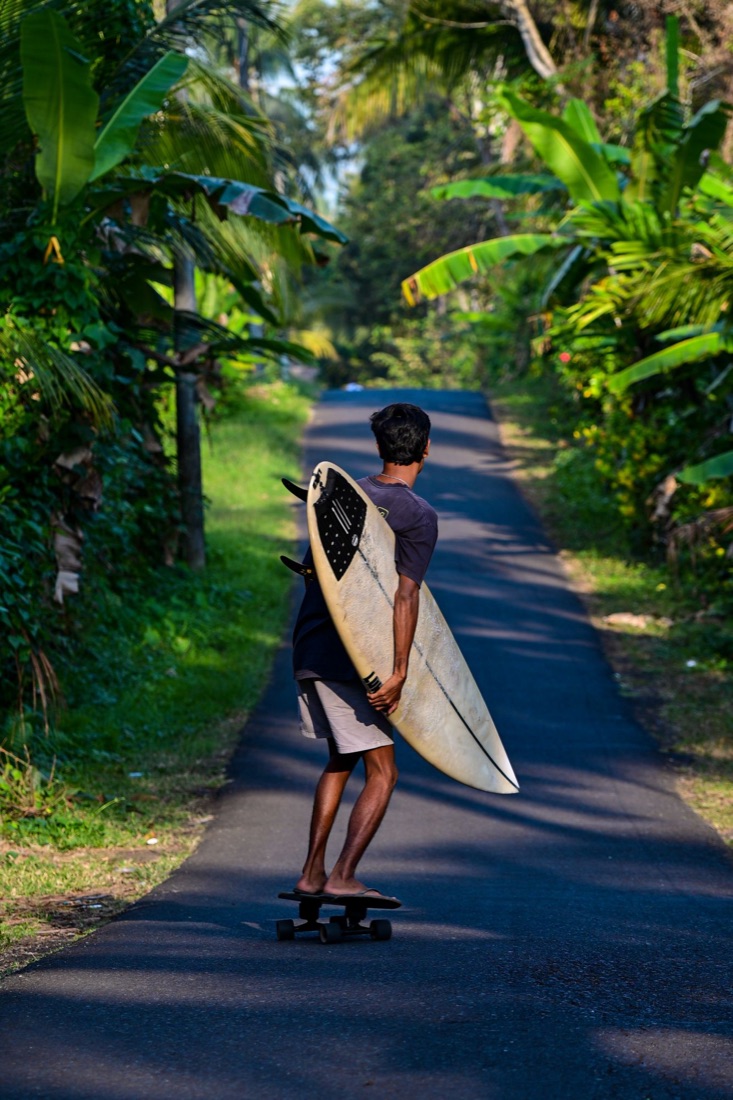
A surfskate is a skateboard with a front truck that pivots far more than a normal one. That one change lets the board swing underneath you instead of just leaning, so you can pump it forward on flat ground and set a rail the way you would on a wave. It is not a longboard with soft wheels. The whole design exists to reproduce one feeling.
What it teaches you
Generating your own speed. Pumping on a surfskate is the same movement as pumping down the line: compress, extend, push through the board rather than pushing off the ground. Surfers who learn to pump on land stop relying on the wave to do everything for them.
The order a turn happens in. Eyes, then shoulders, then hips, then board. On a wave this is over in a second and you cannot feel the parts. On a skate you can slow it down, get it wrong, and feel exactly which piece you skipped. Almost always it is the eyes.
Rail to rail. Moving your weight from toe edge to heel edge and back, smoothly, without a pause in the middle. This is what makes surfing look connected rather than like a series of separate moves.
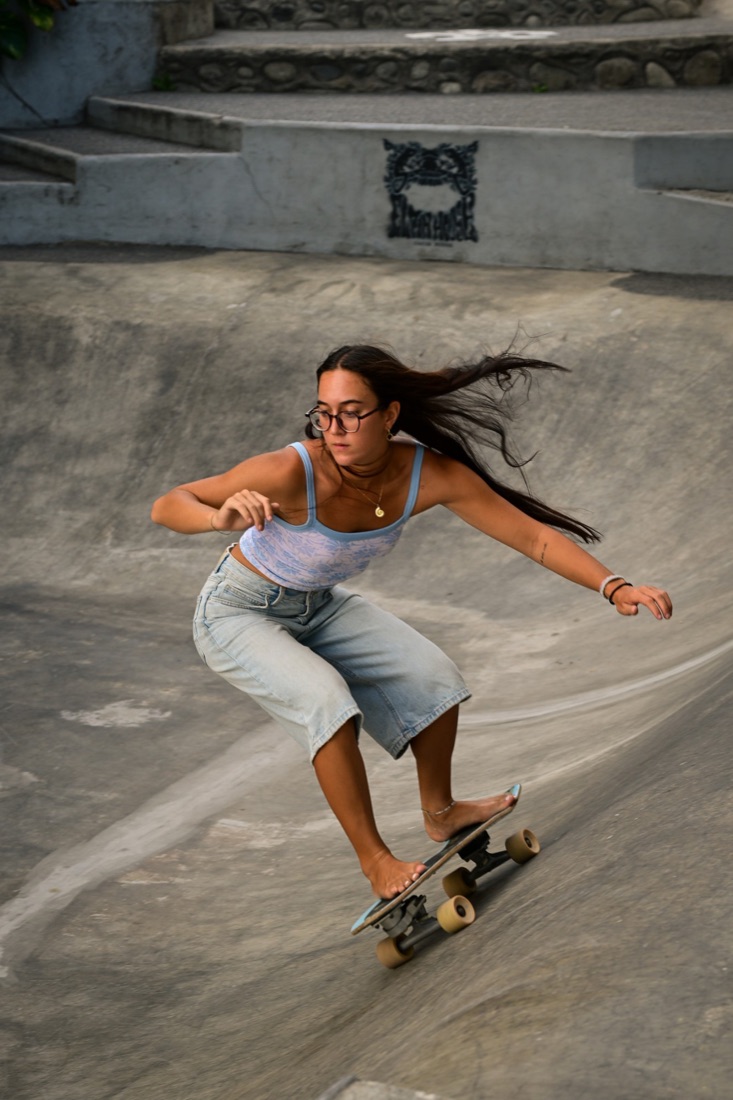
A stance that holds up. Knees bent, chest over the front foot, back straight. Ten minutes of skating will tell you more about your posture than an hour of being told about it.
What it cannot teach you
Being honest about this matters, because surfskates get oversold. Concrete does not move. It will not teach you paddling, wave reading, takeoff timing, or what to do when the section in front of you stands up unexpectedly. It will not prepare you for the drop.
A surfskate is a rehearsal room, not a stage. It makes the movement automatic so that when the wave finally gives you the chance, you are not thinking about your shoulders.
How we use it here
Two stages, and the order matters.
Flat ground first. A quiet stretch of village road, no gradient, no obstacles. Stance, then pumping, then simple turns. Nobody moves on until they can pump the length of the road without putting a foot down.
Then the bowl. Curved concrete does something flat ground cannot: it forces you to link turns in continuous motion, with timing that comes from the transition rather than from you. That is the closest thing to a wave you will find on land.
The one drill worth doing
If you only take one thing from this: rehearse the cutback.
Pick a mark on the ground and treat it as the foam. Ride away from it, then turn back towards it while keeping your eyes locked on it the entire time. Do not turn your shoulders on purpose. Just look, and let the rotation travel down through your body.
Most surfers discover within a few attempts that they have been forcing their shoulders round and wondering why the board did not follow. The drill fixes something in ten minutes that takes months to fix in the water.
Practical notes
- Twenty minutes is plenty. This is coordination work, not fitness. Tired legs teach bad habits.
- Wear shoes. Barefoot looks better in photos, but concrete and toes are a bad combination and a cut foot costs you surf days.
- Do it between sessions, not instead of them. The point is to bring the movement back to the water while it is still fresh.
- Protect your wrists. Falling on a skate is the most common way to lose a week of surfing on a Bali trip.
Quick answers
Is a surfskate good for beginners? Yes, for stance and balance. But learn the pop-up in the water first. A surfskate is no substitute for the first days on a soft board.
Does surfskating really transfer to surfing? The body mechanics of a turn transfer well: where you look, how you rotate, how you move your weight. Wave reading and timing do not. Use it for the first, not the second.
Do I need my own board? Not here. We have boards you can use, and you are welcome to skate with us between sessions.
How long before I feel a difference in the water? Most guests notice their bottom turn feels different within a week. The cutback takes longer, because it needs both the movement and the wave reading.
Want to see where your turn actually breaks down? That is what the video analysis is for, and it pairs with skate work better than either does alone. New to turning altogether? Start with the first maneuvers.